
How to Become an AI Engineer in 2025: A Step-by-Step Guide
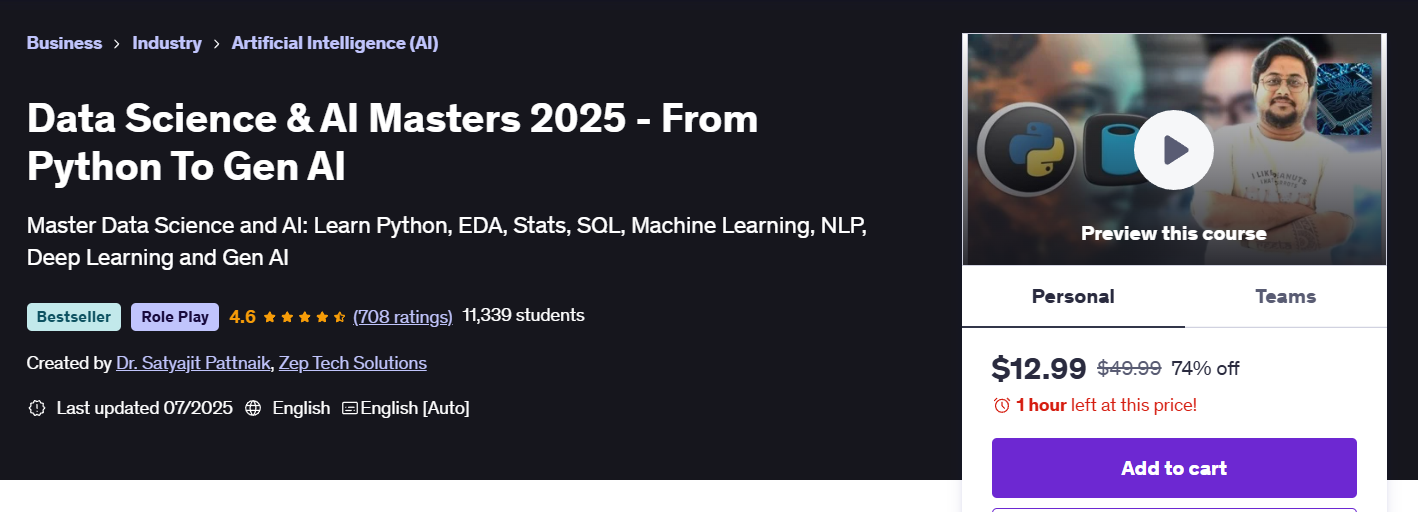
The field of artificial intelligence (AI) is booming, with AI engineers in high demand across industries like tech, healthcare, finance, and more. If you’re aspiring to become an AI engineer in 2025, the "Data Science & AI Masters 2025 - From Python To Gen AI" course on Udemy provides a comprehensive roadmap to build the skills you need. This 95-hour bootcamp, created by Dr. Satyajit Pattnaik and Zep Tech Solutions, covers everything from Python programming to generative AI, making it an ideal starting point for beginners and professionals alike. Here’s a step-by-step guide to becoming an AI engineer in 2025, leveraging the curriculum from this course.
Why Become an AI Engineer in 2025?
AI engineers design, develop, and deploy intelligent systems that solve real-world problems, from chatbots to self-driving cars. The demand for AI professionals is skyrocketing, with salaries often exceeding $150,000 for entry-level roles in the U.S.. This course equips you with the technical expertise and hands-on experience to stand out in this competitive field, even if you’re starting from scratch.
Below is the detailed curriculum of what can make you an AI Engineer, along with the modules, you will also find some relevant resources that you can explore!!
Step 1: Master Python Programming
Course Module: Python Programming
Python is the backbone of AI development due to its simplicity and robust libraries like NumPy, Pandas, and TensorFlow. The course begins with the basics of Python, teaching you how to write efficient code for AI applications. You’ll learn:
Core Python Concepts: Variables, data types, loops, functions, and object-oriented programming.
Libraries for AI: How to use NumPy for numerical computations and Pandas for data manipulation.
Action Plan:
Dedicate 1-2 hours daily to coding exercises provided in the course.
Build small projects, like a simple calculator or data parser, to reinforce your skills.
Explore Python libraries like Matplotlib for visualization to prepare for data-heavy AI tasks.
Why It Matters: Python’s versatility makes it the go-to language for AI engineers, enabling you to handle data processing, model development, and deployment.
🎯 Resource: Click here
Step 2: Build a Strong Foundation in Data Analysis
Course Module: Exploratory Data Analysis (EDA) and Statistics
AI engineering requires understanding data, as models rely on clean, well-analyzed datasets. The course covers EDA and statistical methods, which are critical for uncovering insights and preparing data for machine learning.
EDA Techniques: Learn to visualize data using tools like Matplotlib and Seaborn to identify patterns and trends.
Statistics: Master probability, hypothesis testing, and regression analysis to understand the math behind AI algorithms.
Action Plan:
Practice EDA on real-world datasets (e.g., from Kaggle) to identify outliers and trends.
Complete the course’s hands-on exercises, such as visualizing sales data or analyzing customer behavior.
Study statistical concepts like p-values and confidence intervals to evaluate model performance.
Why It Matters: Data analysis skills ensure you can preprocess and interpret data, a core component of AI model development.
🎯 Resource: Click here
Step 3: Learn SQL for Data Management
Course Module: SQL
AI engineers often work with large datasets stored in databases. The course teaches SQL to manage and query data effectively, a must-have skill for handling structured data in real-world AI projects.
SQL Skills: Write queries to extract, filter, and aggregate data from relational databases.
Practical Applications: Learn to integrate SQL with Python for seamless data workflows.
Action Plan:
Practice SQL queries using free platforms like SQLite or MySQL.
Complete course projects, such as querying a customer database to extract insights.
Learn to optimize queries for large-scale AI applications.
Why It Matters: SQL enables you to handle the massive datasets common in AI, ensuring efficient data retrieval for model training.
🎯 Resource: Click here
Step 4: Dive into Machine Learning
Course Module: Machine Learning
Machine learning (ML) is the heart of AI engineering. The course covers a range of ML algorithms, from linear regression to clustering, using Python’s Scikit-learn library.
Supervised Learning: Build models for regression and classification tasks, like predicting house prices or customer churn.
Unsupervised Learning: Explore clustering techniques like K-Means for pattern discovery.
Model Evaluation: Learn to assess models using metrics like accuracy, precision, and recall.
Action Plan:
Implement ML algorithms from the course, such as decision trees or support vector machines, on sample datasets.
Participate in Kaggle competitions to apply ML skills to real-world problems.
Experiment with hyperparameter tuning to optimize model performance.
Why It Matters: ML forms the foundation of AI systems, enabling you to create models that learn from data and make predictions.
🎯 Resource: Click here
Step 5: Explore Deep Learning and Neural Networks
Course Module: Deep Learning
Deep learning powers advanced AI applications like image recognition and natural language processing. The course introduces deep learning with TensorFlow and PyTorch, focusing on neural networks and their architectures.
Neural Networks: Understand multilayer perceptrons (MLPs), convolutional neural networks (CNNs), and recurrent neural networks (RNNs).
Frameworks: Gain hands-on experience with TensorFlow and PyTorch for building and training models.
Action Plan:
Build a simple neural network to classify images (e.g., handwritten digits from the MNIST dataset).
Follow the course’s deep learning projects, such as creating a sentiment analysis model.
Experiment with pre-trained models using transfer learning to accelerate development.
Why It Matters: Deep learning is essential for cutting-edge AI applications, from autonomous vehicles to voice assistants.
🎯 Resource: Click here
Step 6: Master Natural Language Processing (NLP)
Course Module: Natural Language Processing
NLP is a critical area for AI engineers, enabling systems to understand and generate human language. The course covers the full NLP pipeline, from preprocessing to model deployment.
Text Processing: Learn to clean and preprocess text data using libraries like NLTK and SpaCy.
Transformer Models: Understand how transformers revolutionized NLP and implement them for tasks like text classification.
Applications: Build chatbots and sentiment analyzers using NLP techniques.
Action Plan:
Complete the course’s NLP projects, such as building a chatbot with Langchain.
Experiment with pre-trained models like BERT from Hugging Face for tasks like text summarization.
Practice tokenization and word embeddings to process text data efficiently.
Why It Matters: NLP powers AI applications like virtual assistants and automated content generation, making it a high-demand skill.
🎯 Resource: Click here
Step 7: Embrace Generative AI
Course Module: Generative AI and Large Language Models (LLMs)
Generative AI, including LLMs like GPT, is transforming industries. The course dives into advanced topics like Retrieval-Augmented Generation (RAG), Langchain, and prompt engineering.
LLMs: Explore the architecture and applications of LLMs for tasks like content generation and question answering.
RAG and Langchain: Learn to combine retrieval techniques with generative models for enhanced AI performance.
Prompt Engineering: Master crafting effective prompts to optimize LLM outputs.
Action Plan:
Build a generative AI project, like a text-to-image generator or an AI-powered Q&A system.
Experiment with vector databases (e.g., Chroma or Pinecone) for efficient storage of embeddings.
Practice prompt engineering to fine-tune LLM responses for specific use cases.
Why It Matters: Generative AI is at the forefront of innovation, powering tools like ChatGPT and Stable Diffusion.
🎯 Resource: Click here
Step 8: Build Real-World Projects
Course Module: Real-World Projects
The course emphasizes hands-on learning through projects that simulate real-world challenges, helping you build a portfolio to showcase to employers.
Project Examples: Create AI applications like a recommendation system, chatbot, or predictive model.
Portfolio Development: Compile your projects into a GitHub repository to demonstrate your skills.
Action Plan:
Complete all course projects, ensuring they address real-world problems (e.g., predicting stock prices or analyzing customer reviews).
Document your projects with clear READMEs and visualizations to impress recruiters.
Share your portfolio on LinkedIn and job platforms like Indeed or Glassdoor.
Why It Matters: A strong portfolio demonstrates practical experience, making you more attractive to employers.
Check out Dr. Satyajit Pattnaik's YouTube channel for multiple project ideas :)
Step 9: Stay Updated and Network
AI is a rapidly evolving field, so continuous learning and networking are crucial. While the course provides a solid foundation, you’ll need to stay current with industry trends.
Follow Industry Leaders: Engage with experts like Dr. Satyajit Pattnaik (the course instructor) on LinkedIn or YouTube for insights and updates.
Join Communities: Participate in AI communities on Reddit, Discord, or X to exchange ideas and learn about new tools.
Explore Advanced Topics: Dive into emerging areas like agentic AI or reinforcement learning through additional courses or research papers.
Action Plan:
Subscribe to AI newsletters like Import AI or The Algorithm by MIT Technology Review.
Attend virtual or in-person AI conferences, such as NeurIPS or local meetups.
Contribute to open-source AI projects on GitHub to gain experience and visibility.
Why It Matters: Networking and staying updated keep you competitive in the fast-paced AI industry.
Step 10: Land Your First AI Engineer Role
With the skills from the course and a robust portfolio, you’re ready to apply for AI engineer roles. Focus on positions like Junior AI Engineer, Machine Learning Engineer, or Data Scientist.
Job Search: Look for roles on platforms like LinkedIn, Indeed, or specialized AI job boards like AI-Jobs.net.
Tailor Your Resume: Highlight your course projects, Python proficiency, and knowledge of ML, NLP, and generative AI.
Prepare for Interviews: Practice explaining your projects and brush up on algorithms, data structures, and AI concepts.
Action Plan:
Apply to 5-10 jobs weekly, customizing your resume for each role.
Prepare for technical interviews using platforms like LeetCode or HackerRank.
Leverage the course’s Q&A section to clarify doubts and strengthen your understanding.
Why It Matters: A strategic job search and strong interview performance are key to securing your first AI role.
Final Thoughts
Becoming an AI engineer in 2025 is an achievable goal with the right roadmap. The "Data Science & AI Masters 2025 - From Python To Gen AI" course offers a structured, hands-on approach to mastering Python, data analysis, machine learning, deep learning, NLP, and generative AI—everything you need to succeed. By following this guide, completing the course’s projects, and staying engaged with the AI community, you’ll be well on your way to a rewarding career as an AI engineer.
Enroll in the course today, commit to consistent learning, and take the first step toward shaping the future of AI. The journey may be challenging, but the rewards are worth it. Start now, and by the end of 2025, you could be building cutting-edge AI solutions for the world’s top companies!
Ready to Begin? Check out the course on Udemy: Data Science & AI Masters 2025 - From Python To Gen AI.
- Satyajit Pattnaik
- Jul, 30 2025
