
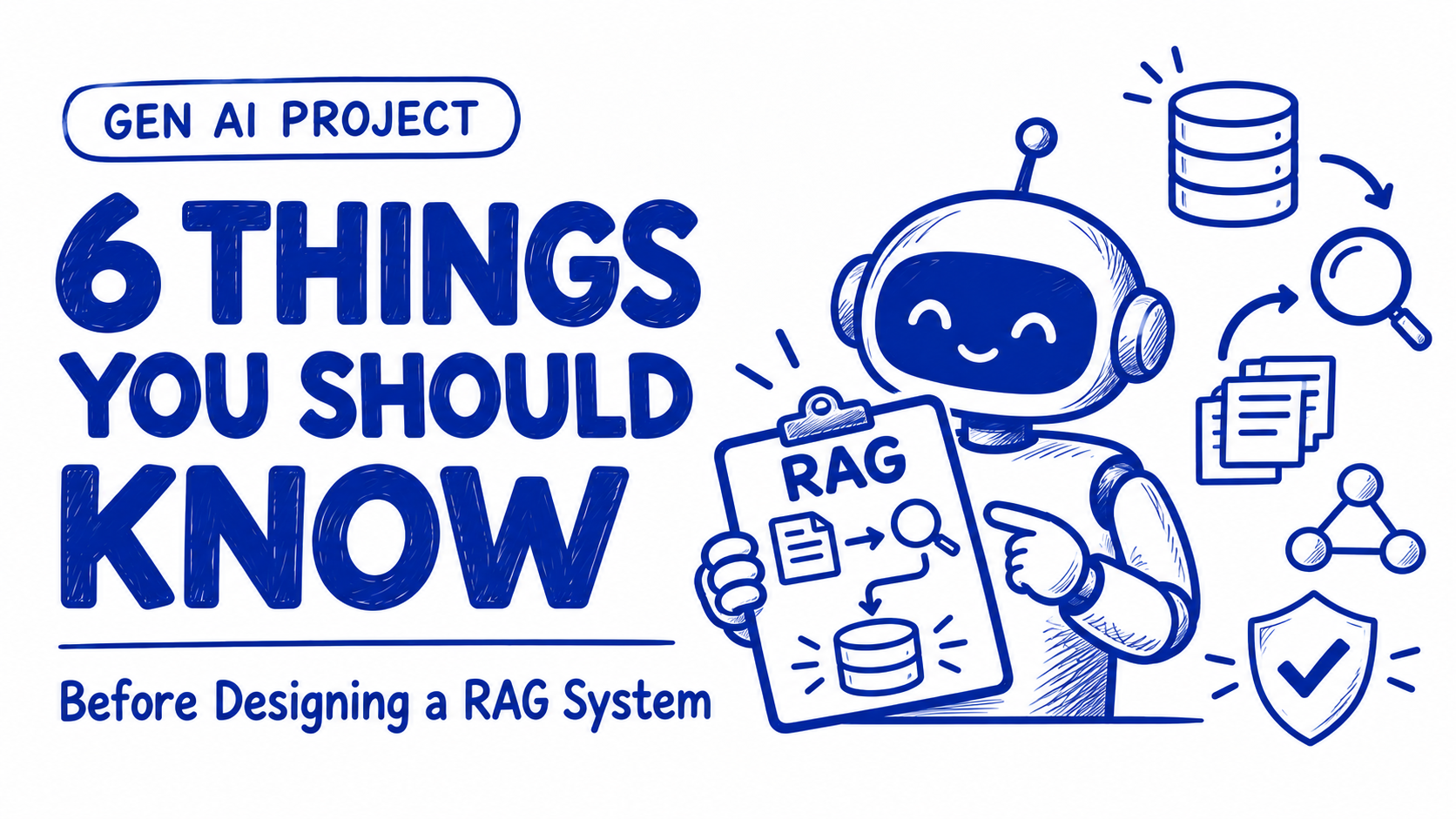
Building a Retrieval-Augmented Generation (RAG) system is easy to prototype, but making it accurate, reliable, and production-ready is a different challenge.
RAG isn't just about connecting an LLM to a vector database. It's about ensuring the right information reaches the model at the right time.
Here are six things worth getting right.
1. Data Quality Comes First
Your RAG system is only as good as the data it retrieves. Clean documents, remove duplicates, preserve metadata, and ensure your knowledge base stays updated.
2. Chunking Can Make or Break Retrieval
Breaking documents into smaller chunks improves searchability, but poorly designed chunks can lose important context. Experiment with chunk size, overlap, and semantic boundaries.
3. Retrieval Matters More Than You Think
Vector similarity alone isn't always sufficient. Combining semantic search with keyword-based retrieval (hybrid search) and reranking can improve the relevance of retrieved information.
4. More Context Doesn't Mean Better Answers
Sending excessive information to an LLM increases token costs and can introduce irrelevant context. Focus on retrieving fewer, highly relevant passages rather than simply filling the context window.
5. Evaluate the Entire Pipeline
Don't measure success only by how convincing an answer sounds. Track retrieval relevance, answer faithfulness, citation accuracy, latency, and cost. Test with real user questions.
6. Design for Security and Scale
Production RAG systems need access controls, protection against prompt injection, proper source attribution, and monitoring. A system that works for 100 documents may behave differently with a million.
Final Thought
A great RAG system isn't built by choosing the most powerful LLM. It's built by designing a smarter retrieval pipeline.
Start simple, measure what matters, and optimize based on real-world performance.
Want to learn more about designing RAG systems?
Explore this video for a deeper discussion:
https://www.youtube.com/live/8QRvKCCp2B0?si=GMSiSvlE1ShT_2aY