
Your AI assistant can write a convincing answer. But can it find the latest policy, follow your organisation’s classification rules, and complete a task across multiple systems?
Those are three different requirements—and they often need different solutions.
When comparing RAG vs fine-tuning vs agents in 2026, start with the problem your application needs to solve:
- Use RAG when the model needs relevant information from external sources.
- Use fine-tuning when the model needs to learn a repeatable response pattern or task behaviour.
- Use agents when the model needs to choose tools and adapt its next steps.
A production application may combine all three. However, each additional component should solve a measurable problem.
This guide explains when to use each approach, how they fit into real-world applications, and how to combine them using LangGraph.
RAG vs Fine-Tuning vs Agents: Quick Comparison
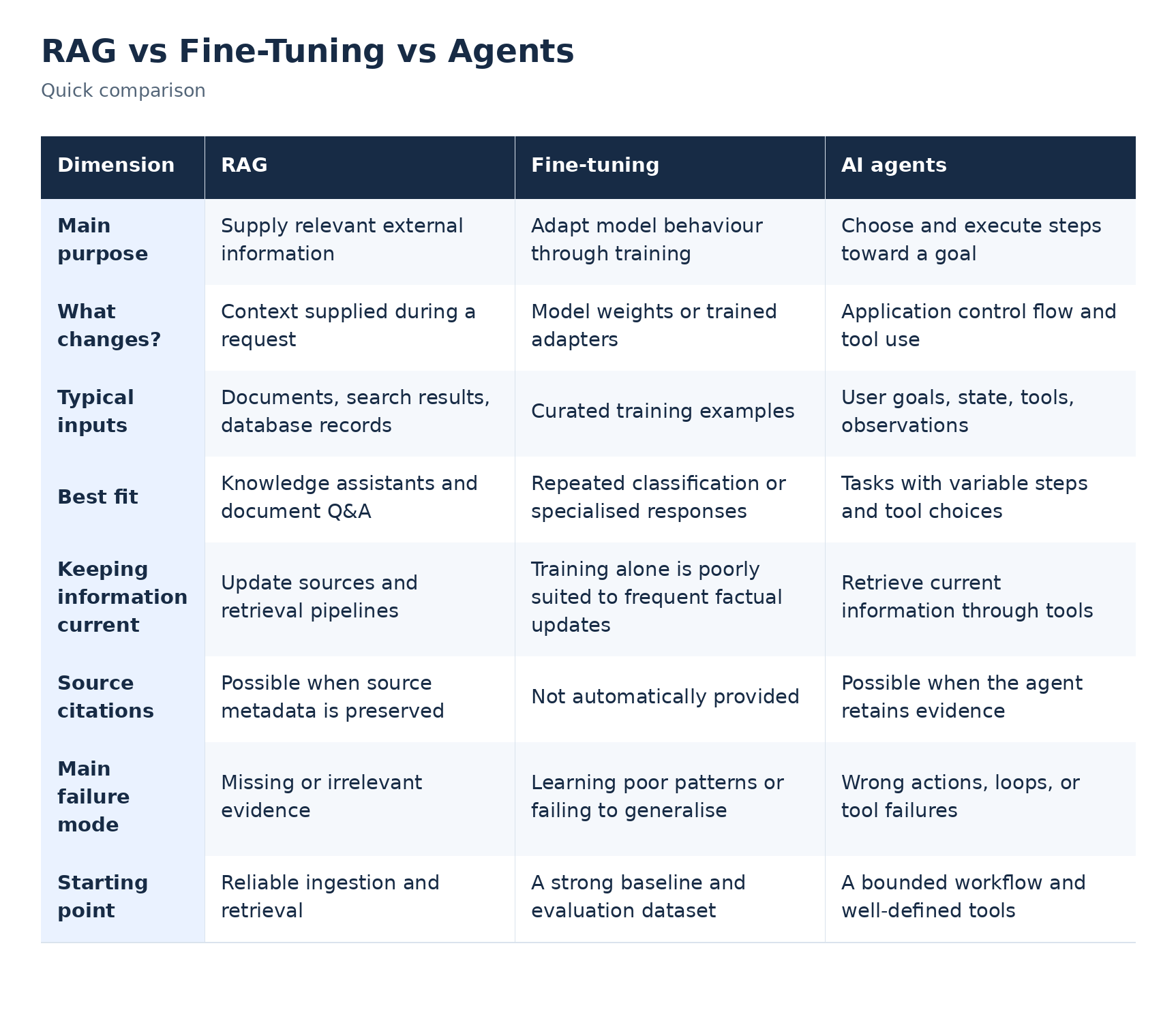 These approaches operate at different layers. Retrieval supplies information, training adapts behaviour, and agent orchestration coordinates execution.
What Is RAG?
Retrieval-augmented generation, or RAG, retrieves information from external sources and supplies it to a language model before it generates an answer.
For example, a support assistant answering a warranty question could retrieve the relevant product policy and use that passage to explain the terms.
The model does not need to memorise every policy. The application provides the relevant evidence when needed.
Retrieval can use keyword search, semantic search, or a hybrid approach. It does not always require a vector database. OpenAI’s retrieval documentation explains semantic retrieval and hybrid ranking options.
When should you use RAG?
RAG is a strong starting point when:
- Answers depend on private or frequently updated information.
- Users need citations or links to supporting documents.
- The knowledge collection is too large to include in every prompt.
- Different users have permission to access different sources.
Typical applications include internal knowledge assistants, product support, research tools, and document intelligence.
What RAG does not solve automatically
Retrieving a passage does not guarantee a correct answer.
A system can retrieve an outdated document, miss an exception, or cite a page that does not support its conclusion. Good RAG therefore needs evaluation at two levels: did it retrieve the right evidence, and did it use that evidence correctly?
For a PDF application, preserve document versions, page numbers, headings, and table relationships during ingestion. Those details often matter more than adding another model call.
What Is Fine-Tuning?
Fine-tuning adapts a pretrained model using additional training data. In supervised fine-tuning, those examples demonstrate the outputs you want for particular inputs.
For example, a model could learn to classify support messages into a company’s category system or produce assessments that follow an expert-reviewed rubric.
Hugging Face’s SFT Trainer documentation provides an implementation path for supervised fine-tuning. Hugging Face
When should you use fine-tuning?
Consider fine-tuning when:
- The task is repeated frequently.
- The desired behaviour is reasonably stable.
- You have representative, high-quality examples.
- Prompting and simpler controls have reached a measurable limit.
- An evaluation set can show whether training improves performance.
A useful diagnostic question is:
Does the model have the information it needs but still handle the task inconsistently?
If yes, fine-tuning may be worth testing.
If the model lacks the latest policy, training is usually not the first fix. Supply the missing context.
Try simpler controls first
If the problem is malformed JSON, start with structured outputs and schema validation.
If the problem is an unclear response format, improve the prompt and provide examples.
Fine-tuning becomes more compelling when these approaches still leave repeatable errors. OpenAI’s model accuracy guide similarly distinguishes problems involving missing context from problems involving inconsistent behaviour.
What Are AI Agents?
An AI agent uses a model to choose actions, call tools, inspect results, and decide what to do next.
For example, a career assistant might search job listings, compare requirements with a CV, ask for missing preferences, and revise its shortlist.
The distinction between an agent and a workflow matters:
- A workflow follows predefined execution paths.
- An agent gives the model discretion over some steps or tool choices.
Both can use language models. Both can include retrieval. Anthropic’s agent design guide explains this distinction and recommends starting with the simplest architecture that meets the task. anthropic.com
When should you use agents?
Use an agent when the application cannot reliably determine all required steps in advance.
Examples include investigating an incomplete case, researching across different sources, or choosing among tools based on intermediate results.
When every request follows the same sequence—extract, validate, save—a conventional workflow may be easier to test and operate.
When to Use RAG vs Fine-Tuning: A Decision Framework
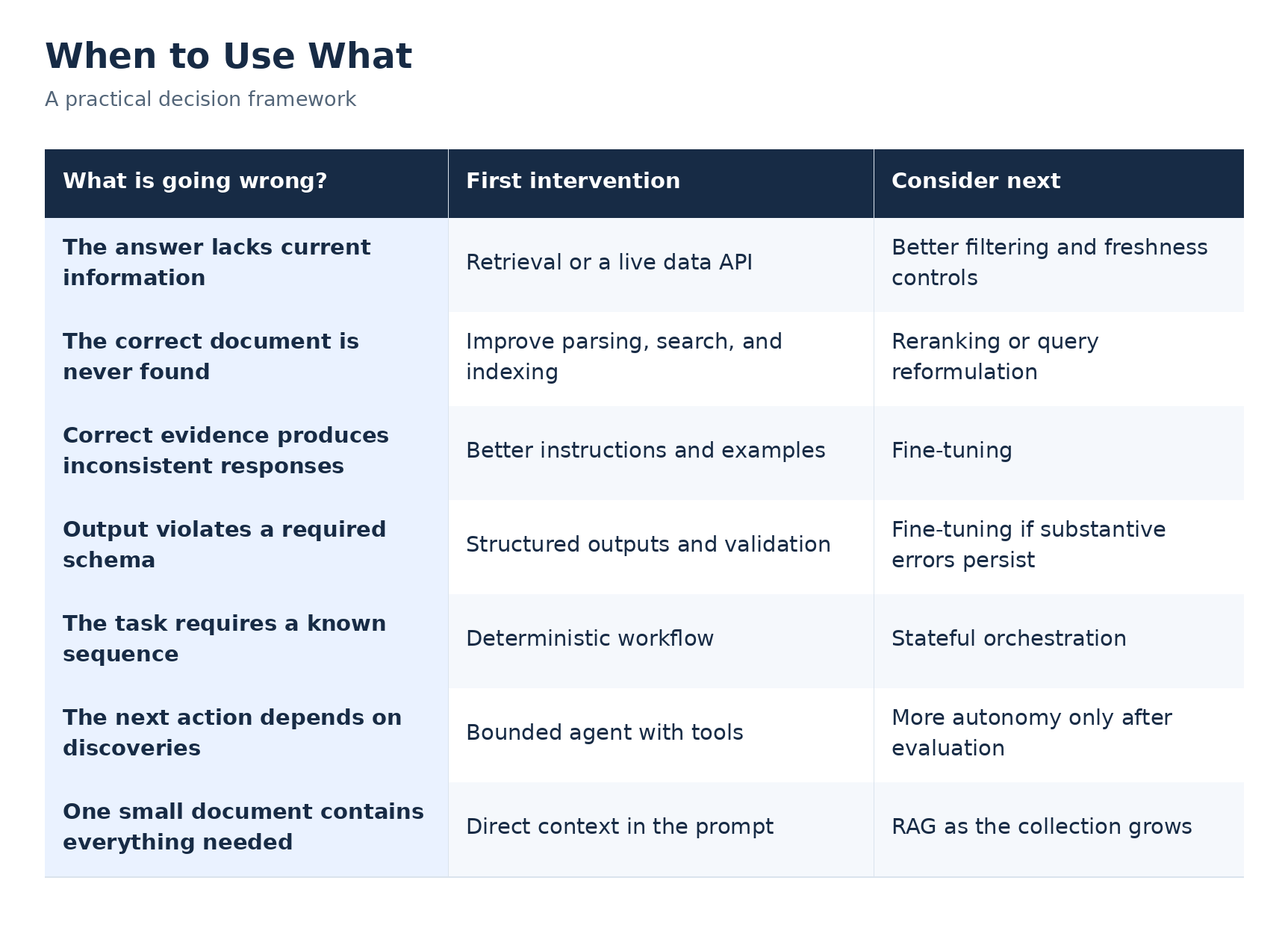
Decision flowchart
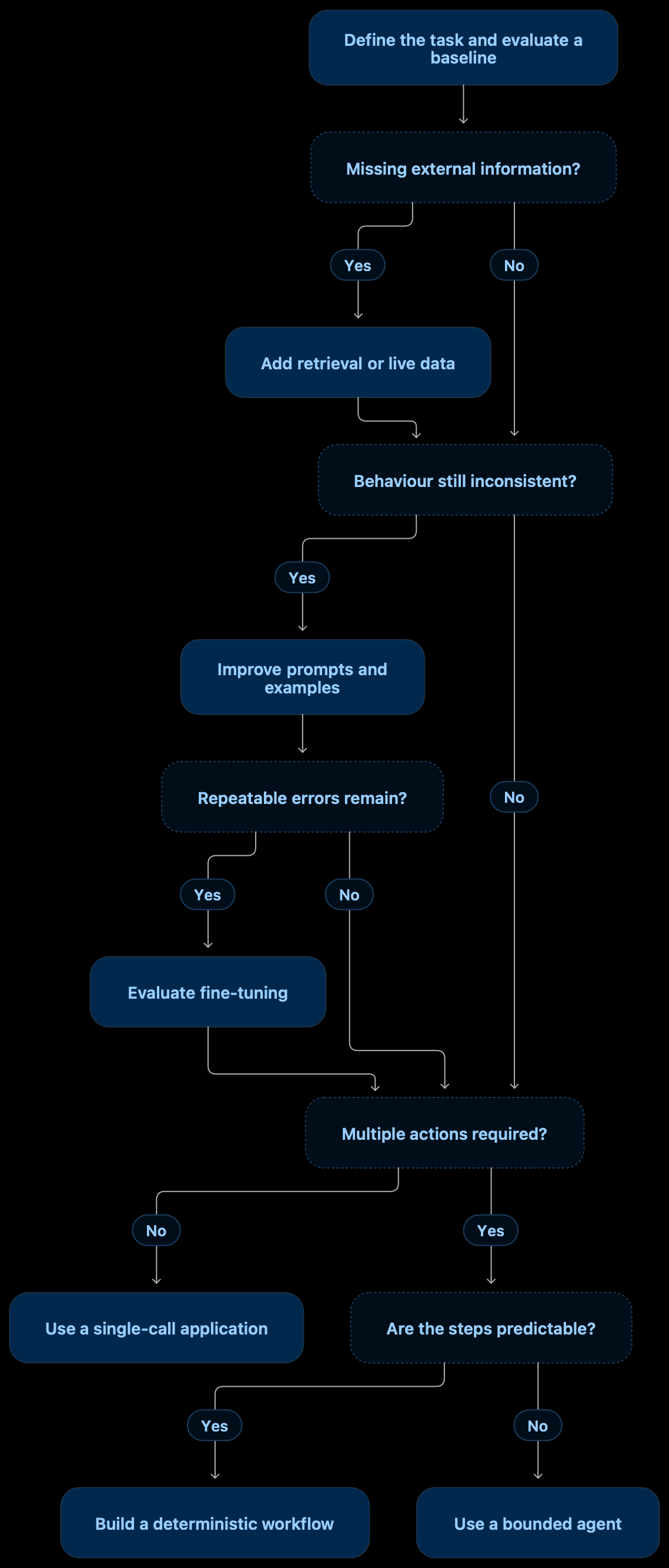
Figure 1. Choose components based on observed failures. Multiple components can apply to the same application.
Practical Example 1: Claims Processing
Consider an assistant that prepares an insurance claim for a human reviewer.
The input includes a claim form, invoices, supporting documents, and a policy reference.
Where RAG fits
Retrieve the applicable policy wording, endorsements, exclusions, and document requirements.
The retrieval layer should filter by the relevant policy version and case context. Finding a similar clause from the wrong policy can produce a persuasive but incorrect assessment.
Where fine-tuning fits
Fine-tuning could help with a repeated classification task, such as mapping varied document descriptions into an established taxonomy.
It might also improve consistency in an assessment format—if experiments show that prompting and structured outputs are insufficient.
Where an agent fits
An agent can help investigate incomplete evidence by choosing the next permitted lookup.
However, a predictable process for checking required fields and routing a case can remain deterministic. The system should distinguish a draft recommendation from an authorised decision.
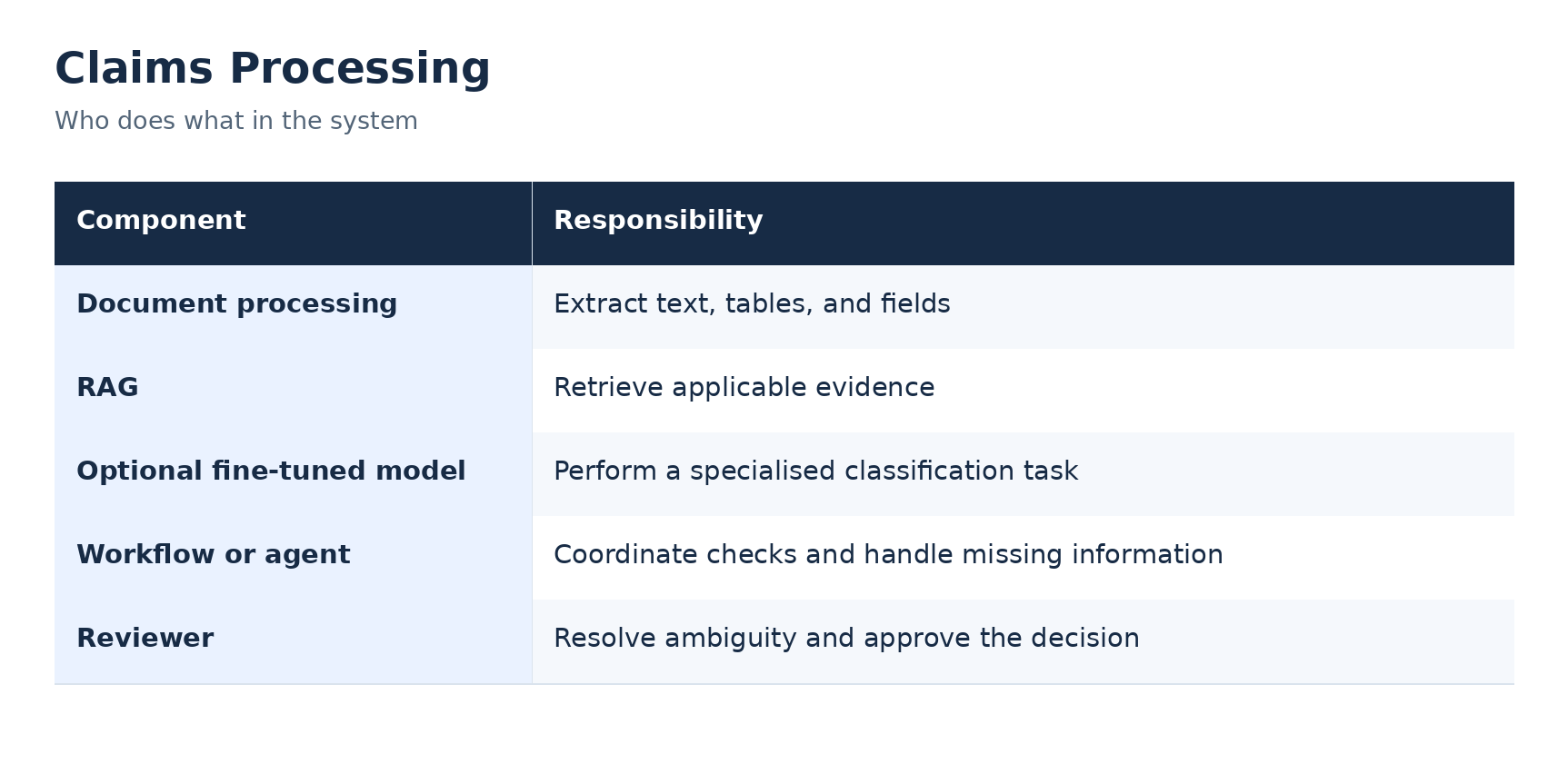
Suggested starting architecture: RAG plus a controlled review workflow. Add fine-tuning only after identifying a persistent, measurable task-specific weakness.
Practical Example 2: PDF Intelligence
A user uploads a collection of reports and asks:
“Which documents describe delivery delays, and what reasons do they give?”
This is a strong retrieval use case because the answer depends on evidence distributed across documents.
Start with the document pipeline
Extract text accurately, preserve tables, and attach document titles and page references to searchable passages.
Then retrieve relevant evidence and generate a response that links each finding to its source.
Fine-tuning will not repair an ingestion pipeline that loses a table’s column headings.
When agentic retrieval helps
An agent becomes useful when the question needs several searches.
It might search for delivery delays, discover that a report uses the phrase “fulfilment disruption,” and run another query using that terminology.
LangGraph’s custom RAG agent tutorial demonstrates retrieval, relevance grading, query rewriting, and answer generation. Docs by LangChain
Suggested starting architecture: conventional RAG with source references. Add adaptive retrieval when evaluation shows that a single search regularly misses necessary evidence.
Practical Example 3: AI Career Coach
A user asks:
“Review my CV, find suitable roles, and create a four-week preparation plan.”
This request combines personal information, current opportunities, and planning.
Use retrieval for relevant information
Retrieve the user’s CV, selected job descriptions, and learning resources. Use current job data through an appropriate search or API integration.
Store user preferences in application state rather than retraining a model for each person.
Use fine-tuning for a stable coaching approach
A curated set of expert-reviewed examples could teach the model to apply a consistent feedback rubric.
For instance, it might learn how to prioritise evidence-backed CV improvements and distinguish required skills from optional ones.
Use an agent for adaptive assistance
An agent can decide whether it needs to ask about location, search for additional roles, or revise a plan after the user changes their availability.
Drafting an application and submitting it should be separate actions, with explicit user approval for submission.
Suggested starting architecture: retrieval plus a bounded assistant with user state. Add fine-tuning if expert evaluation reveals persistent weaknesses in coaching quality.
How to Combine RAG, Fine-Tuning, and LangGraph
A combined architecture gives each component a specific responsibility:
- RAG retrieves evidence.
- A base or fine-tuned model interprets that evidence.
- LangGraph coordinates state, branches, and execution.
- Validation checks determine whether the result can proceed.
LangGraph supports both workflows and agents. Using it does not automatically make an application autonomous. Its documentation covers predefined paths as well as model-directed tool use. Docs by LangChain
Example hybrid architecture
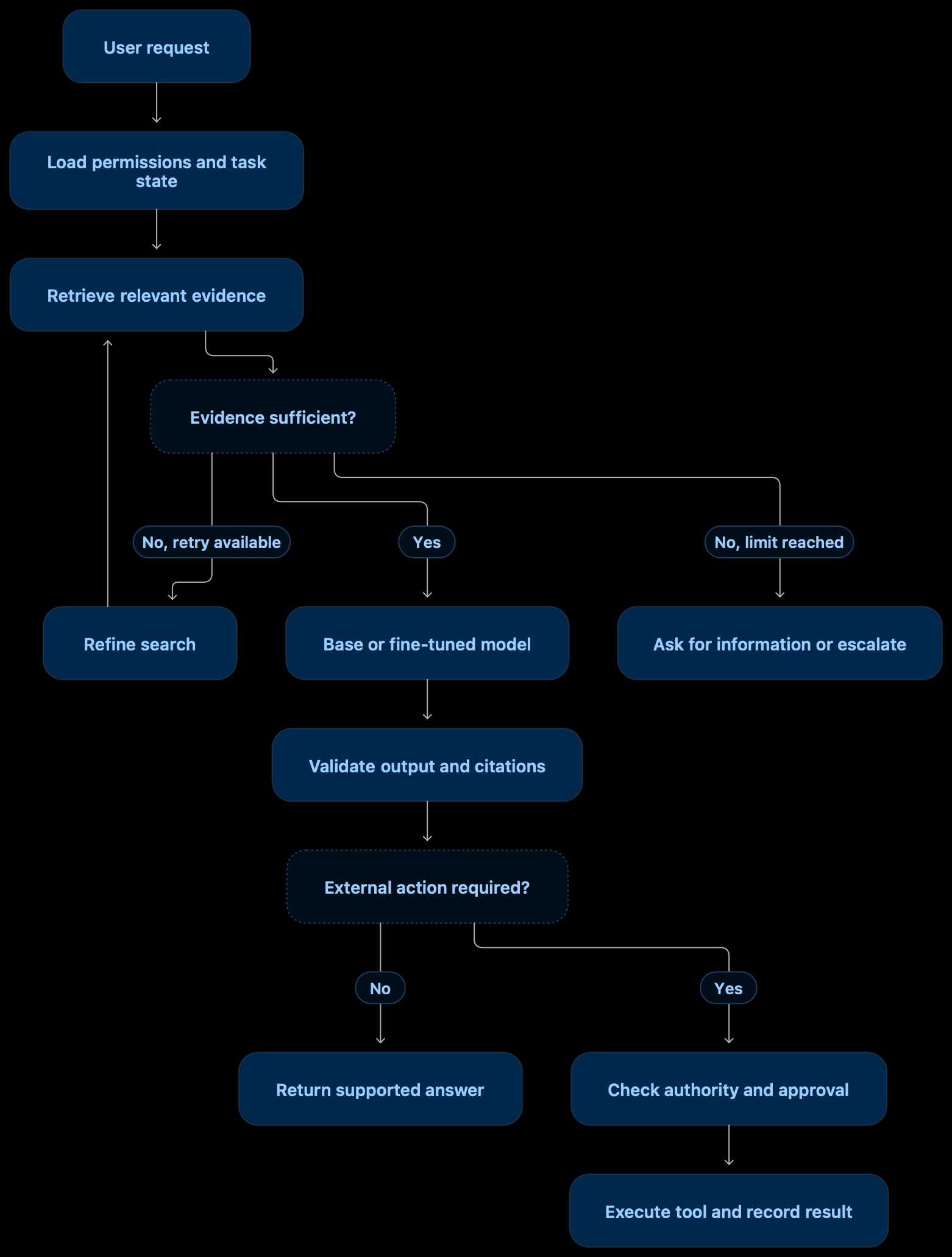
Figure 2. A bounded hybrid system combines evidence retrieval, model behaviour, and controlled execution.
Fine-tuning is optional here. First evaluate whether the base model already performs well with the retrieved evidence.
LangGraph Agents Tutorial: Design a Bounded RAG Loop
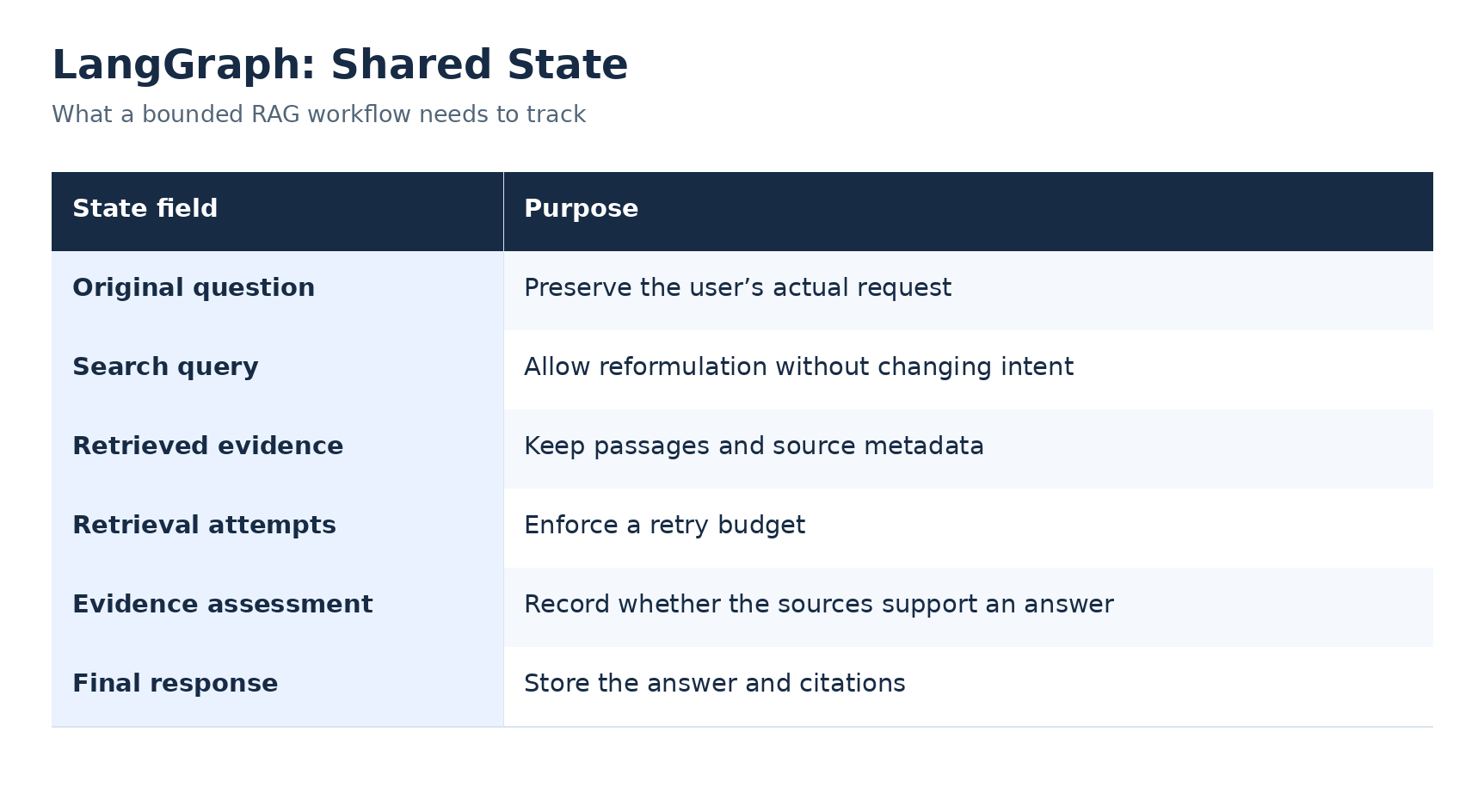
A useful first implementation is a document assistant that can improve a weak search without retrying indefinitely.
Step 1: Define shared state
Step 2: Define the nodes
Create separate nodes for retrieval, evidence assessment, query rewriting, answer generation, and fallback.
Keeping these responsibilities separate makes failures easier to inspect.
Step 3: Add bounded routing
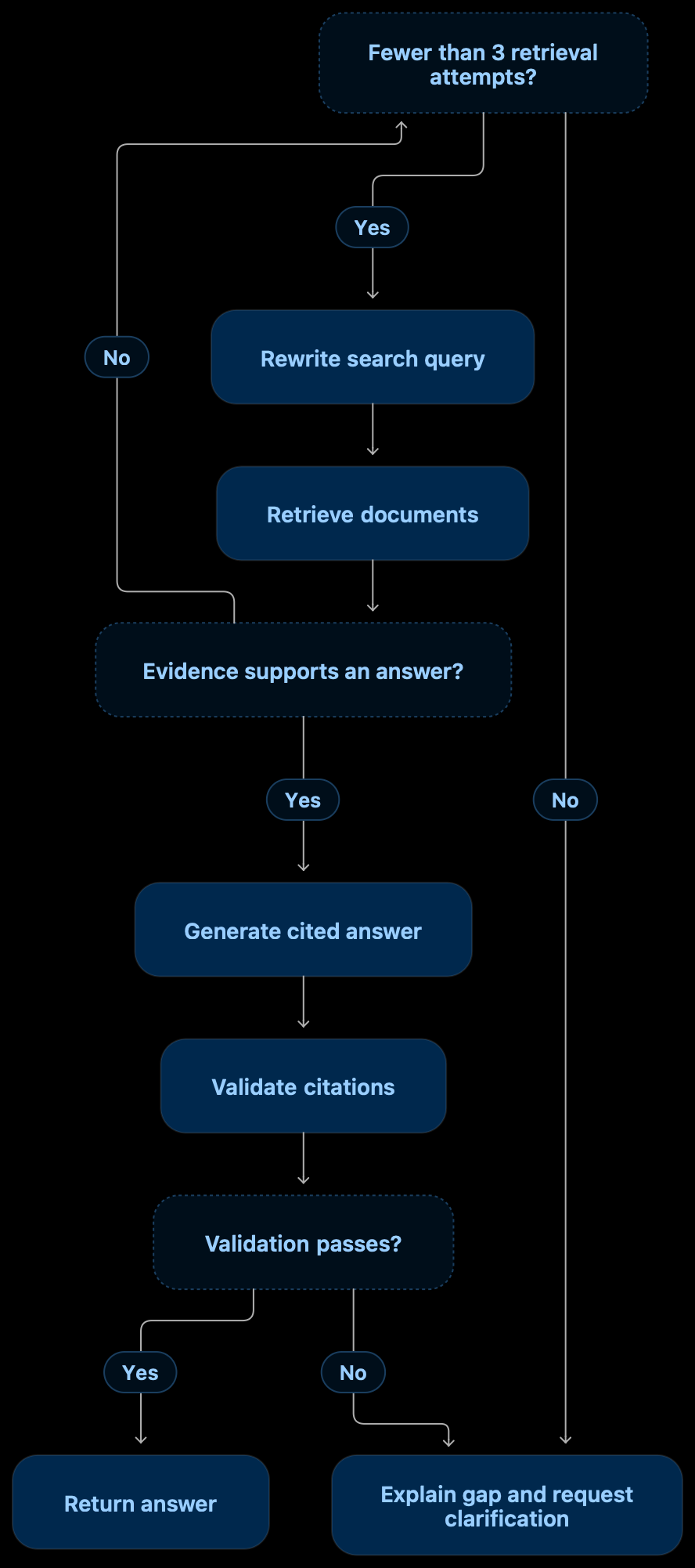
Figure 3. Example design with a maximum of three retrieval attempts. The limit is an application choice, not a LangGraph default.
Step 4: Test the failure paths
Test a question with clear evidence, one with no answer, one with conflicting sources, and one where the first search misses the relevant passage.
A relevance grader is itself fallible. Evaluate its decisions rather than treating its score as proof.
Step 5: Add persistence when needed
For conversations or interrupted tasks, checkpoint the graph state. LangGraph distinguishes thread-scoped checkpoints from stores used for information across threads; in-memory persistence does not survive a process restart. See the persistence documentation. Docs by LangChain
For executable code, follow the official LangGraph RAG agent tutorial, then add explicit retry budgets and application-specific validation.
Cost, Latency, and Maintenance Trade-Offs
There is no universal cheapest or fastest approach. The comparison depends on model choice, context size, traffic, tool calls, and the required success rate.
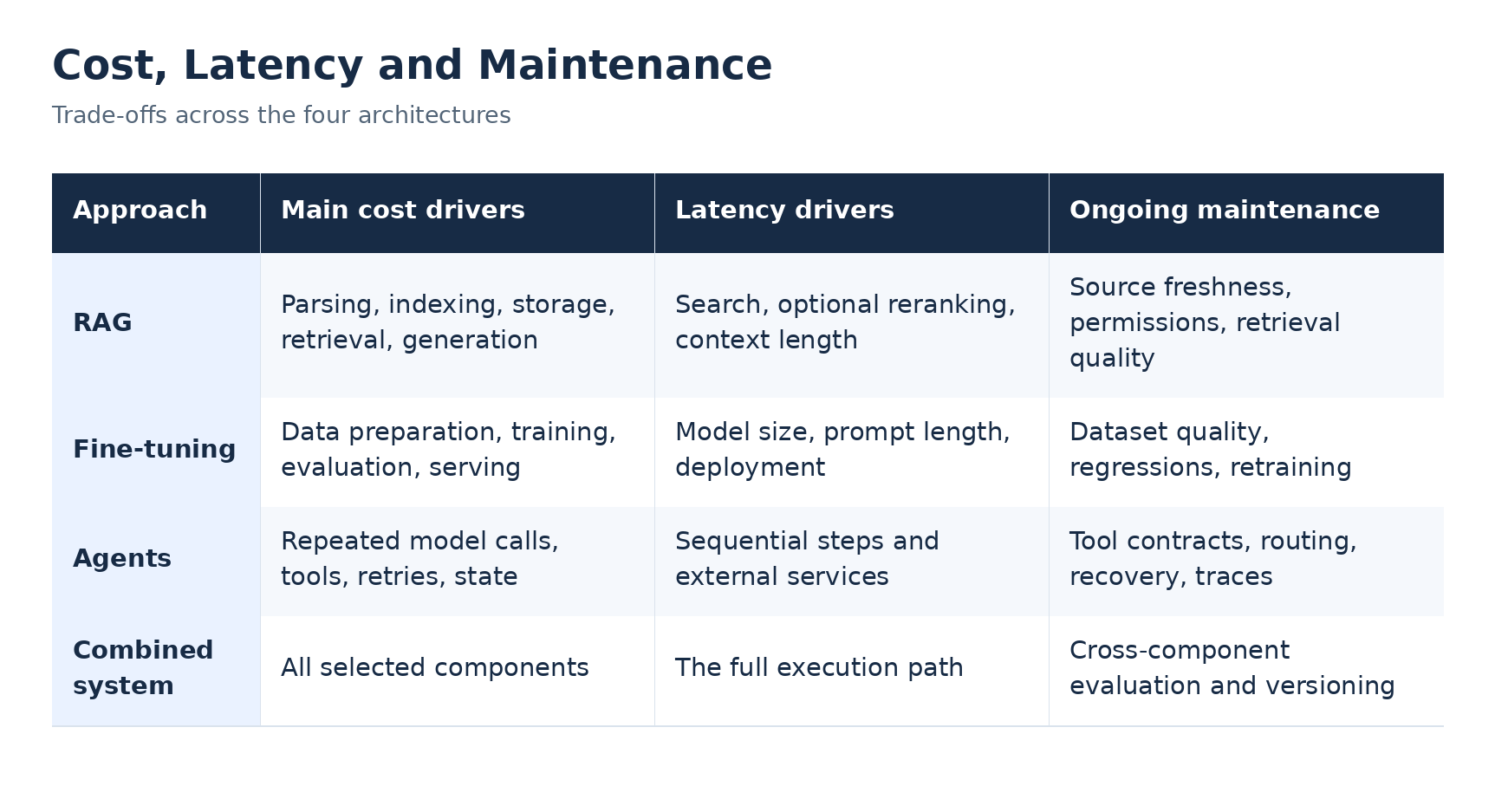
Compare cost per successful task
A cheap response is not necessarily a cheap outcome.
Use:
Cost per successful task = Total operating cost ÷ Successfully completed tasks
For illustration, suppose System A costs $100 to process 10,000 tasks and successfully completes 8,000. Its cost per success is $0.0125.
System B costs $120 and completes 9,600 successfully. Its cost per success is also $0.0125.
These are hypothetical figures, not provider prices or benchmark results.
Include human review and rework when they materially affect the business outcome.
When can fine-tuning save money?
Fine-tuning may reduce costs if it allows a smaller model or shorter prompts to meet the same quality target. Those savings must outweigh training, data preparation, and maintenance.
A simple break-even estimate is:
Break-even volume = Upfront investment ÷ Net saving per request
If the investment is $2,000 and the verified net saving is $0.002 per request, break-even occurs at one million requests—before additional maintenance costs.
How should you measure latency?
Measure both median and p95 latency, plus time to a useful result.
A streaming response may start quickly while the underlying task still takes a long time. Agents with multiple sequential tool calls can have especially variable completion times.
What Should You Measure Before Adding Complexity?
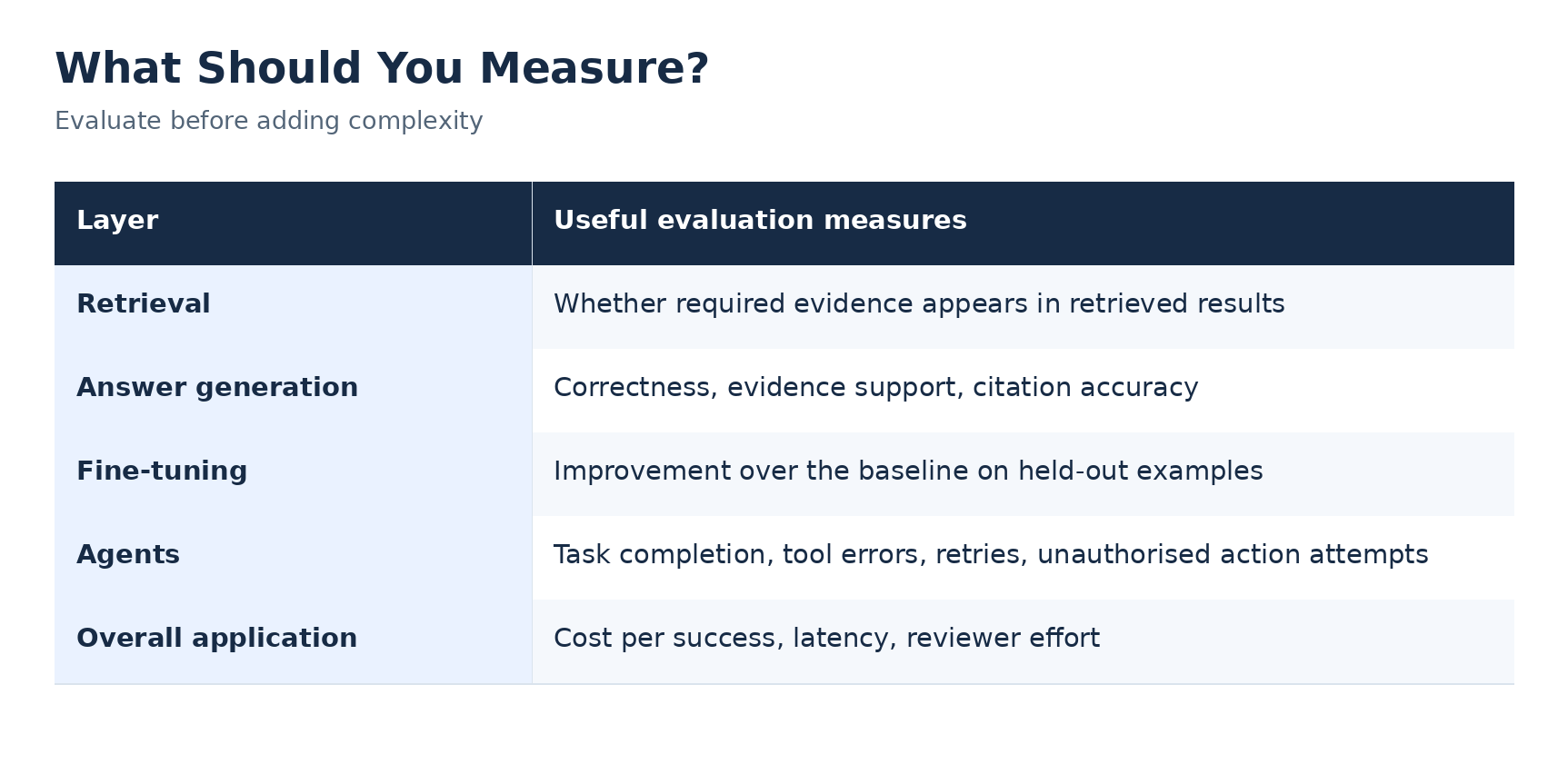
For fine-tuning, keep evaluation examples separate from training data. For retrieval, verify that test answers are supported by the source collection. For agents, evaluate completed outcomes as well as individual responses.
People Also Ask
Is RAG better than fine-tuning?
RAG is generally a better fit for supplying changing or private information. Fine-tuning is useful for adapting repeatable behaviour. Choose based on the failure you need to fix, and compare results against a baseline.
Can RAG and fine-tuning be used together?
Yes. Retrieval can supply current evidence while a fine-tuned model applies a specialised classification or response pattern. Evaluate the combination against RAG with a base model to check whether training adds value.
Does fine-tuning eliminate hallucinations?
No. A trained model can still generate unsupported statements. Fine-tuning should be paired with appropriate evaluation, validation, and evidence access where the task requires it.
Do AI agents replace RAG?
No. An agent can call a retrieval tool as one of its actions. Agentic RAG allows the system to make decisions about retrieval, such as reformulating a query or searching another source.
Does every chatbot need LangGraph?
No. A straightforward chatbot may need only a model call and retrieval. LangGraph becomes useful when explicit state, conditional paths, pauses, or recovery are meaningful requirements.
Is a larger context window enough to replace RAG?
For a small, manageable document collection, supplying the full context can be a practical baseline. Retrieval becomes useful when you need selective access across a larger collection or tighter control over relevance and context cost.
Which approach is cheapest?
There is no fixed winner. Compare total cost at the same quality target, including retries, infrastructure, training, and human rework.
Choose the Architecture That Fixes the Actual Problem
Before adding RAG, fine-tuning, or agents, inspect a representative set of failures.
If evidence is missing, improve information access. If behaviour remains inconsistent despite good context, test better prompting and then fine-tuning. If completing the task requires adaptive tool use, introduce a bounded agent.
For claims processing, PDF intelligence, and career coaching, the best starting point is usually a small, measurable system. Add each component when you can explain the failure it addresses—and demonstrate the improvement.
Start with one task, one baseline, and a clear definition of success.